
Australia Just Expanded Psychedelic Therapy Access, and Raised the Bar for Practitioners

Quick answer: In 2026, Australia's Therapeutic Goods Administration (TGA) updated its Authorised Prescriber pathway for MDMA-assisted therapy (PTSD) and psilocybin-assisted therapy (treatment-resistant depression). The changes allow psychiatrists to qualify through supervised experience, broaden who may serve in the therapy dyad, ease continuous on-site psychiatrist presence requirements, and permit care in approved non-hospital settings, while keeping screening, consent, and safety obligations fully intact.
Master the Science. Steward the Soul.
The next phase of psychedelic medicine will not be defined by who is most fascinated by the field.
It will be defined by who is prepared to practice inside its legal, ethical, and clinical architecture.
That is the deeper signal coming from Australia's recent updates to its psychedelic access pathway. While public attention often moves toward the medicines themselves, psilocybin for treatment-resistant depression, MDMA for PTSD, ketamine-assisted care in medical settings, the more important professional story is happening around the container:
Who may participate
Where care may take place
What level of oversight is required
How patient safety is protected
Which practitioners can demonstrate the training, competence, and scope required to hold this work responsibly
For the serious practitioner, this is where the question becomes personal.
You may already see clients, colleagues, and institutions becoming more curious. You may already sense that psychedelic medicine is moving from the margins toward regulated systems of care.
But curiosity does not create readiness.
A psychedelic therapy career asks for a different kind of preparation: clinical discernment, deep regulatory literacy, and the capacity to honor both the science and the sacred dimensions of this work without confusing reverence for looseness.
Australia's Therapeutic Goods Administration has now clarified and broadened elements of its Authorised Prescriber pathway. The changes may make access more workable, but they do not remove the seriousness of the work.
They sharpen it.
And for anyone researching psilocybin facilitator training, how to become a psilocybin facilitator, or a long-term psychedelic therapy career, this is the lesson worth studying: the frontier is opening, but it is opening with standards.
What Did Australia's TGA Actually Change?
Australia's Therapeutic Goods Administration updated requirements for its Authorised Prescriber pathway for MDMA-assisted therapy for PTSD and psilocybin-assisted therapy for treatment-resistant depression, the two indications Australia approved for clinical use in 2023.
The updates followed input from 83 stakeholders, including authorised psychiatrists, professional bodies, and others involved in delivering psychedelic-assisted care. The changes were not made because the field had become simple. They were made because the early version of the pathway revealed practical friction: Authorised Prescriber applicants, Human Research Ethics Committees, and the TGA itself encountered procedural challenges that made access difficult to implement at scale.
The agency's stated goal was balance, improve appropriate access to emerging unapproved psychedelics while keeping strong safeguards in place for patient safety.
That sentence contains the future of the field. Access and safeguarding are not opposing forces. They are the two pillars that will determine whether psychedelic medicine can mature responsibly.
The updated guidance centers on four areas. Each has implications for professionals preparing to enter this work.
1. Psychiatrist competence can now be built through supervision
Few psychiatrists have direct experience in psychedelic clinical trials. The TGA will now consider psychiatrists who can show they have received supervision in the modality from an experienced Authorised Prescriber.
This is not a lowering of standards, it is recognition that competence must have a realistic pathway in an emerging field. Mastery here will be built through layered learning, supervised exposure, ethical reflection, and ongoing refinement.
A title alone is not enough. A personal interest is not enough. The work asks for stewardship.
2. More practitioners may enter the care team
The TGA broadened who may participate in the therapy dyad. At least one member must be registered with one of four national boards; the second must demonstrate appropriate skills, training, and competence relevant to psychedelic-assisted psychotherapy, with the Authorised Prescriber psychiatrist responsible for determining that competence.
Psychedelic care is becoming more interdisciplinary, but not informal. A psychiatrist may carry prescribing responsibility. A registered practitioner may bring clinical scope. A trained professional may support preparation, client presence, integration, education, or operational continuity.
For someone exploring a psychedelic therapy career, the message is clear: opportunity is growing, but opportunity follows competence. This is where psilocybin facilitator training and specialized clinical education become career infrastructure rather than résumé decoration, especially when chosen with attention to legal context, clinical boundaries, and ethical service.
3. Oversight is becoming more workable
The Authorised Prescriber psychiatrist remains responsible for patient screening, suitability assessment, and ongoing informed consent, and must be physically present during medicine administration. But the updated guidance clarifies that continuous on-site presence throughout the full dosing day is not required.
This preserves medical oversight while acknowledging the practical realities of care delivery. It also reinforces something every practitioner in this field must internalize: know where your role begins, where it ends, and when another professional must be involved.
Scope is not a limitation on service. Scope is one of the ways service remains clean.
4. Care settings may expand beyond hospitals
Stakeholders strongly supported allowing treatment beyond traditional hospital environments, and the TGA responded by defining what an appropriate site must include: secure storage and chain of custody for the medicines, appropriate equipment and staff, and proximity within fifteen minutes of an emergency department.
This is the most revealing part of the update. The setting may become warmer, more accessible, less institutionally rigid, but it must still be prepared. The room may hold beauty, but it must also hold protocol.
That is Changa's position in a sentence: the vessel matters. Clinical readiness and reverent space are not separate disciplines. They belong in the same conversation.
How Australia's Model Compares to Oregon, Colorado, and New Mexico
Australia's pathway is nationally medicalized through the TGA and centered on Authorised Prescriber psychiatrists. The United States has taken a different route, state-level frameworks, each with its own regulator:
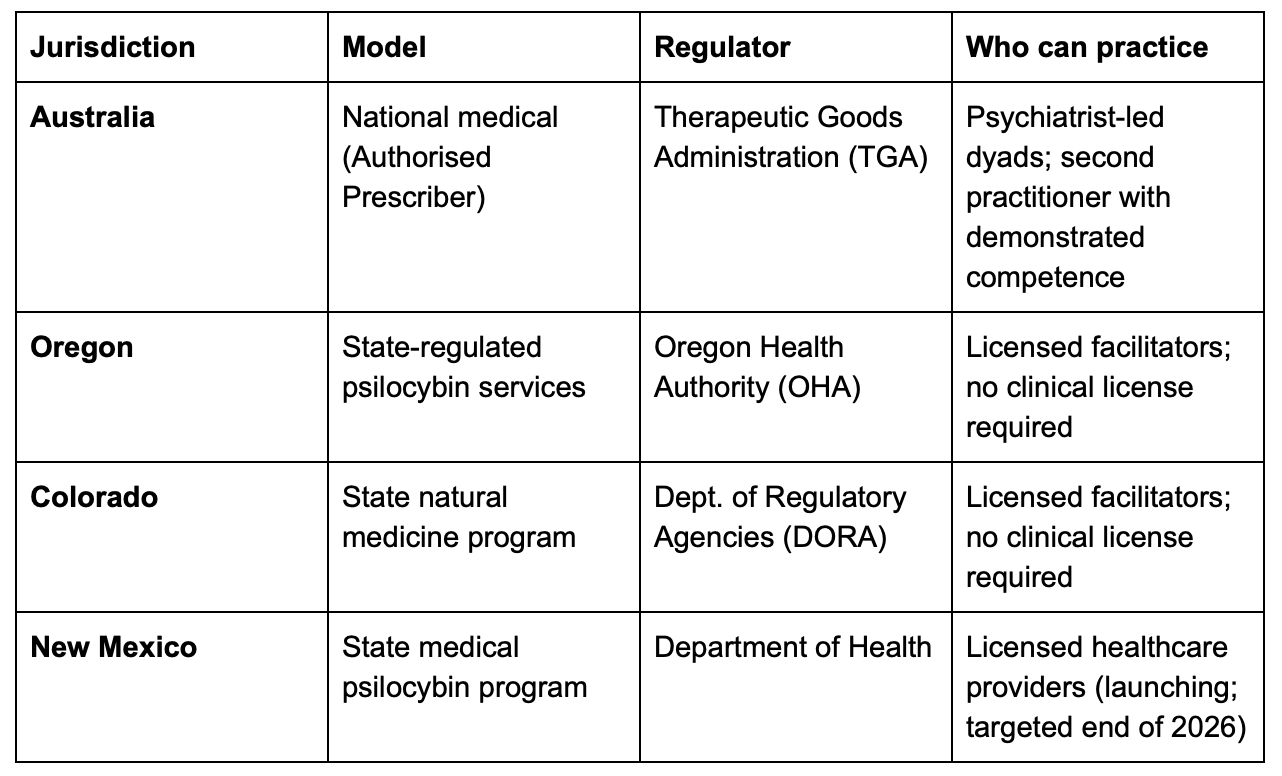
Different structures, but a shared signal: psychedelic care worldwide is converging on defined roles, documented competence, site standards, safety requirements, and accountable practice.
For anyone searching how to become a psilocybin facilitator, this is essential: the first question is not which pathway sounds most compelling. The first question is where you intend to practice and what the relevant regulator requires.
Legal architecture comes before professional identity. (If you're choosing among the U.S. pathways, our state-by-state guides cover Oregon, Colorado, and New Mexico.)
The Market Is Expanding, but the Bar Is Rising
Industry analysts estimate the global psychedelic drugs market at roughly $4.4 billion in 2026, with projections exceeding $11 billion by 2033. Growth like that draws attention from healthcare systems, private investors, practitioners, and career changers.
But the practitioners this field actually needs are not looking for a shallow entrance into a rising market. They are asking a more selective question: whether this work can become a path of scientific depth, ethical service, and genuine human flourishing, for their clients and for themselves.
Career outcomes in regulated psychedelic care now span preparation and integration support, ketamine-informed care, psilocybin services in regulated jurisdictions, clinical education, research support, retreat operations, and interdisciplinary care coordination. The people most prepared for these roles will be those who understand the difference between access and readiness.
Access opens the door. Readiness determines what happens inside the room.
The Practical Takeaway for Practitioners
Australia's 2026 changes do not suggest that psychedelic care is becoming casual. They suggest that regulated systems are learning how to become more functional.
More practitioners may participate. More sites may become eligible. More patients may eventually receive care. Reimbursement may slowly begin to shift as payors, including Medibank and Australia's Department of Veterans' Affairs, enter the conversation.
Yet the center remains the same: screening, informed consent, emergency readiness, secure medicine handling, professional competence, and clear oversight.
For therapists, coaches, nurses, physicians, mental health professionals, and career changers, the invitation is not to chase the field. It is to become worthy of stewarding it. That requires study. It requires discernment. It requires humility, and a working reciprocity with both modern science and the traditions this medicine comes from.
This is not work to enter because it is popular. It is work to enter because you are ready to become more exacting, more ethical, more internally resourced, and more devoted to the conditions that make human flourishing possible.
Frequently Asked Questions
What did Australia's TGA change about psychedelic therapy access in 2026? The TGA updated its Authorised Prescriber pathway for MDMA-assisted therapy (PTSD) and psilocybin-assisted therapy (treatment-resistant depression): psychiatrists may now qualify through supervised experience, the therapy dyad may include a broader range of competent practitioners, continuous on-site psychiatrist presence is no longer required for the full dosing day, and care may occur in approved settings beyond hospitals.
Is psychedelic-assisted therapy legal in Australia? Yes, in limited form. Since 2023, authorised psychiatrists in Australia may prescribe MDMA for PTSD and psilocybin for treatment-resistant depression through the TGA's Authorised Prescriber scheme. The 2026 updates make that pathway more workable without removing its safeguards.
Can a non-psychiatrist work in psychedelic therapy in Australia? Yes, within limits. The therapy dyad must include at least one practitioner registered with one of four national boards; the second member must demonstrate appropriate skills, training, and competence, as determined by the Authorised Prescriber psychiatrist.
How is Australia's model different from Oregon's or Colorado's? Australia runs a national, psychiatrist-led medical model through the TGA. Oregon and Colorado run state-level facilitator licensing programs (through OHA and DORA respectively) that do not require a clinical license, and New Mexico is launching a state medical program built around licensed healthcare providers.
What does this mean for someone considering a psychedelic therapy career? Every major jurisdiction is converging on the same requirements: documented training, demonstrated competence, defined scope, and regulatory accountability. Start by deciding where you intend to practice, then complete the training pathway that regulator recognizes.
Ready to Find Your Path?
If you are exploring psilocybin facilitator training or a long-term psychedelic therapy career, begin by clarifying where your background, scope, and calling fit within this emerging field.
Take Changa Institute's Journey Quiz to discover the training pathway aligned with your next step.
Sources:
Therapeutic Goods Administration, "Updates to Authorised Prescriber scheme requirements when accessing MDMA and psilocybine"
Psychedelic Alpha, Psychedelic Bulletin #225
Changa Institute is the nation's first government-accredited psilocybin facilitator training program, approved by OHA and HECC in Oregon and DORA in Colorado, with a New Mexico program built for the Medical Psilocybin Act framework.
