
Psilocybin Facilitator Training: Requirements, Hours, Curriculum, and Cost (2026 Guide)
Updated June 2026 · Reviewed by Changa Institute faculty
Quick answer: Psilocybin facilitator training in 2026 requires completing a state-approved program of roughly 150–160 instructional hours covering pharmacology, trauma-informed care, ethics, and crisis response, followed by a supervised practicum (40 hours in Oregon) and, in Colorado, 50 hours of consultation over six months. Candidates must be 21 or older and pass a background check. Tuition at approved programs typically runs $7,000–$12,000, and most students complete training in 4–6 months.
Psilocybin facilitation has moved from the margins of wellness culture into regulated healthcare. Oregon and Colorado now license facilitators through formal state programs, and New Mexico's Medical Psilocybin Act brings a third, clinician-led, framework online, with the Department of Health targeting launch by the end of 2026.
That shift changes what "training" means. The question is no longer where can I learn about psychedelics, it's which program satisfies my state's regulator and actually prepares me to hold this work. This guide covers exactly what state-approved psilocybin facilitator training involves: eligibility, required hours, curriculum, practicum, licensure, and cost.
What Is Psilocybin Facilitator Training?
Psilocybin facilitator training is a state-regulated education pathway that prepares professionals to legally guide clients through psilocybin sessions, screening and preparation, the administration session itself, and post-session integration. Unlike informal psychedelic courses or retreat apprenticeships, approved facilitator training is reviewed and authorized by a state regulator, and completing it is a legal prerequisite for licensure.
In Oregon, training programs are approved by the Oregon Health Authority (OHA) and licensed as career schools by the Higher Education Coordinating Commission (HECC). In Colorado, the Department of Regulatory Agencies (DORA) approves programs under the Natural Medicine Health Act. New Mexico's framework, built around licensed healthcare providers, is administered by the Department of Health.
Changa Institute is the only training program approved by all three of these regulatory bodies, and our graduates were the first licensed psilocybin facilitators in the United States.
Who Is Eligible for Psilocybin Facilitator Training?
Baseline eligibility is more accessible than most people expect, though it varies by state:
Age: at least 21 years old
Education: a high school diploma or equivalent (Oregon and Colorado); New Mexico's program requires an existing healthcare provider license instead
Background check: required for licensure in every regulated state
CPR / Basic Life Support: required by some programs and settings
Residency: no longer a barrier in Oregon, the in-state residency requirement expired, so out-of-state candidates can train and license there
No prior clinical license is required in Oregon or Colorado. In practice, most trainees come from counseling, nursing, medicine, social work, chaplaincy, and coaching backgrounds, but career changers complete the same pathway successfully. (Wondering where you fit? The Changa Journey Quiz maps your background to the right pathway in a few minutes.)
Training Hours and Requirements by State
One of the most common errors in articles about this field is blending Oregon's and Colorado's requirements into a single number. They are different programs with different regulators:
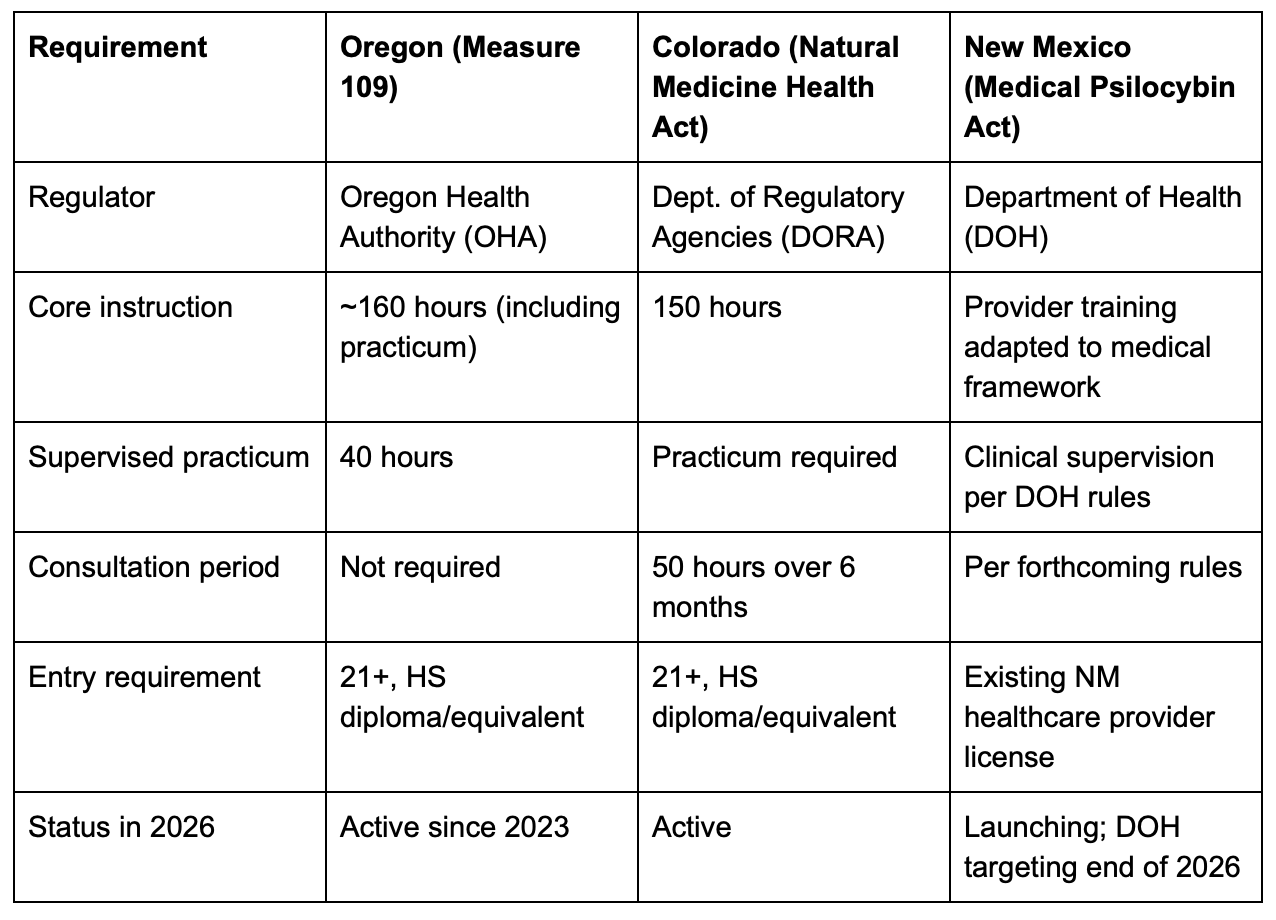
Always verify current requirements with the regulator directly, rules evolve, and a serious training program will keep you current as they do. (Changa's founding team has served on rulemaking committees in all three states, which is why our curriculum tracks regulatory changes before they take effect.)
What an Approved Curriculum Covers
State rules define minimum content areas, but strong programs go well beyond the floor. Expect approved psilocybin facilitator training to include:
The science. Pharmacology of psilocybin, mechanisms of action, contraindications and drug interactions, and the clinical evidence base, including research on treatment-resistant depression, PTSD, substance use disorders, and end-of-life distress.
The craft. Non-directive facilitation skills, therapeutic presence, preparation and screening, navigating challenging experiences, group dynamics, and integration practice.
The responsibility. Trauma-informed care, equity and cultural humility, Indigenous and traditional context for plant medicine, ethics and professional boundaries, scope of practice, and crisis intervention.
The legal container. State regulations, informed consent, documentation, safety protocols, and the operational realities of licensed service centers.
Changa Institute's program delivers this across 14 modules in a 4.5-month, cohort-based hybrid format: live instruction three times weekly on Zoom, four to five hours of weekly self-guided work, and cohorts small enough for genuine mentorship. The full curriculum is published openly, download the complete guide, because a program training people for licensed practice shouldn't make you guess what's inside.
The Practicum: Where Training Becomes Practice
Classroom hours alone don't satisfy any state's requirements, and they shouldn't. Supervised practicum experience with real clients in legal sessions is both a licensure requirement and the stage where facilitation skills actually form.
This is also where programs differ most. Many training providers leave students to arrange their own practicum placements. Changa operates an in-house practicum program at a licensed psilocybin service center in Portland, Oregon, where students complete supervised hours in legal psilocybin sessions. For Colorado candidates, Changa also provides the DORA-required clinical supervision and consultation hours, 50 hours over six months, within the same institution that trained you.
After Training: Licensure and Practice
Once training and supervised hours are complete, you apply for licensure through your state regulator, the Oregon Health Authority in Oregon, DORA in Colorado. Applications require proof of training hours, a background check, and licensing fees; check the current fee schedule with your regulator, as fees change.
Licensed facilitators practice at state-licensed service centers, and may establish their own. The career outlook is covered in depth in our companion guide, How to Become a Certified Psilocybin Facilitator, including roles, salary ranges, and the facilitator-vs-therapist-vs-trip-sitter distinction.
One signal worth weighing when you choose where to train: more than a third of Oregon's licensed psilocybin service centers are operated by Changa alumni. The network you train within is the network you'll practice within.
How Much Does Psilocybin Facilitator Training Cost?
Tuition at state-approved programs typically falls between $7,000 and $12,000. Budget additionally for practicum or consultation fees where priced separately, state licensing and application fees, and CPR/BLS certification if you don't hold it.
Payment plans are common, Changa offers them, and needs-based support exists in the field, including the Sheri Eckert Foundation scholarship for Oregon trainees. Treat unusually cheap programs with the same skepticism you'd bring to unusually cheap flight schools: the regulator sets a floor on hours, not on quality.
Choosing a Training Program: Five Questions That Matter
Is it approved in the state where you'll practice? Approval doesn't transfer between states. Multi-state approval preserves your optionality.
Is the curriculum published in full? If you can't see what you're buying, keep looking.
Is the practicum in-house or your problem? Arranging supervised legal sessions independently is the hardest part of the path.
Who teaches, and what have they actually done? Look for faculty with clinical-trial, facilitation, and regulatory experience.
What do graduates do afterward? Graduation rates, licensure outcomes, and alumni practices are the honest metrics. Changa graduates at an 83% rate, and our alumni operate more than a third of Oregon's licensed service centers.
Ready to Train?
Psilocybin facilitator training is the gateway to one of the most meaningful licensed professions emerging in healthcare, and the practitioners who train rigorously now will define the field's standards for decades.
Start with the Changa Journey Quiz to find the pathway aligned with your background, or explore our state programs directly: Oregon · Colorado · New Mexico.
Frequently Asked Questions
How many hours of training do you need to become a psilocybin facilitator? Oregon requires approximately 160 hours including a 40-hour supervised practicum. Colorado requires 150 hours of instruction plus practicum and 50 hours of consultation over six months. New Mexico's clinician-based requirements are set by the Department of Health.
How long does psilocybin facilitator training take? Core training programs typically run 4–6 months. Changa Institute's program is 4.5 months, with practicum and (in Colorado) the six-month consultation period following.
Do you need to be a therapist to take psilocybin facilitator training? No, in Oregon and Colorado, a high school diploma or equivalent meets the educational requirement. New Mexico's Medical Psilocybin Act is the exception: it requires an existing healthcare provider license.
Can out-of-state residents train and get licensed in Oregon? Yes. Oregon's residency requirement has expired, so candidates from any state can complete approved training and apply for an Oregon facilitator license.
How much does psilocybin facilitator training cost? Tuition at state-approved programs generally runs $7,000–$12,000, plus licensing fees and any separately priced practicum or consultation hours. Payment plans and needs-based scholarships, such as the Sheri Eckert Foundation, can reduce upfront cost.
Which psilocybin facilitator training programs are state-approved? Each state's regulator publishes its approved-program list. Changa Institute is the only program approved by all three major regulatory bodies, OHA and HECC in Oregon and DORA in Colorado, with a New Mexico program built for the Medical Psilocybin Act framework.
Changa Institute is the nation's first government-accredited psilocybin facilitator training program. Our graduates became the first licensed psilocybin facilitators in the United States in 2023 and now operate more than a third of Oregon's licensed service centers.