
Why Psychedelic Training Requires Experiential and Academic Learning
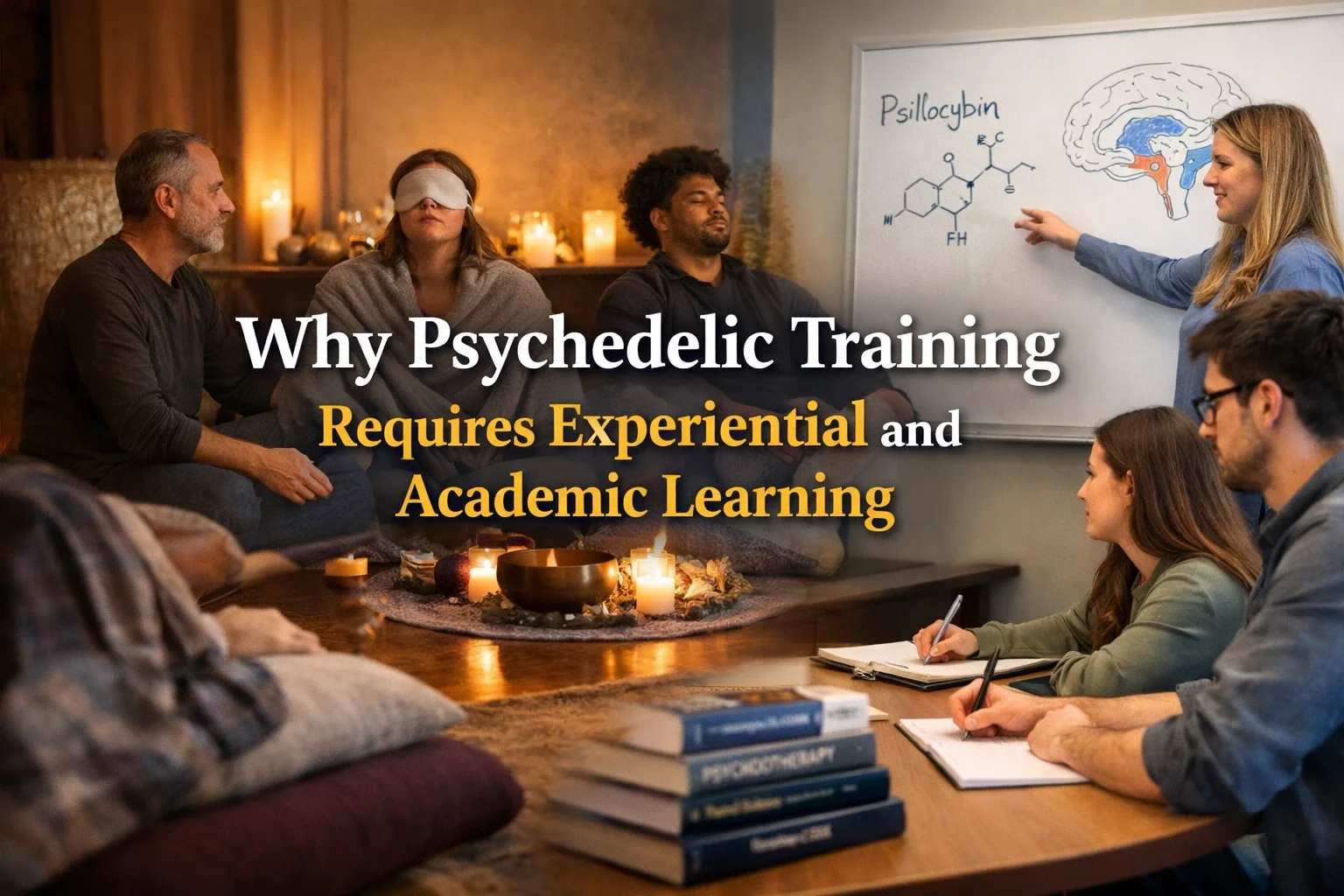
If you’re thinking about a career in psychedelic therapy, you’ve probably noticed that the best training programs don’t just talk about psychedelic experiences. They actually get you ready to help people going through them. This is a really important difference.
Reading about altered states of mind is not the same as knowing what your client feels during a deep psilocybin session. That’s why good psychedelic therapist training combines solid classroom learning with hands-on practice. You can’t become a good, ethical therapist with just one or the other.
Let’s check out why both parts are important, what each one brings to the table, and how to judge training programs with this in mind.
The Academic Foundation: What You Need to Know Before You Practice
Good psychedelic therapy training starts with solid classroom learning. It’s not just about getting a piece of paper, it’s about getting the knowledge you need for working with clients.
Pharmacology and Neuroscience
It’s important to understand how substances like psilocybin, MDMA, and ketamine mess with your brain and body. You gotta know how they work, how long they last, if they mess with other meds, and how your body reacts. This stuff helps you make smart calls about who to screen, how much to give, and spot when things go sideways.
Places like Johns Hopkins and CIIS put this front and center in their courses, and there’s a reason. When someone asks why they feel a certain way, or you gotta explain why they can’t take something, this knowledge becomes useful fast.
Psychology and How Therapy Works
Using psychedelic therapy isn’t something totally new. It relies on years of psychology studies and different ways of treating people. Things like understanding how trauma affects people, how we form attachments, how our bodies play a role in healing, and even spiritual psychology all help make this kind of therapy work well.
A study in 2024 in The Lancet showed that people did better when their therapists knew about both trauma and how to use psychedelics. This makes sense because when someone’s mind is altered, hidden feelings can come up. If the therapist doesn’t have a way to help the person deal with these feelings, they aren’t really helping them fully.
Ethics and the Law
It's important to think about the ethics of working with psychedelics. When people are in that state, they're really open and vulnerable. This means that those guiding them have to be extra careful about boundaries, making sure people truly consent to everything, and being aware of the power they hold. Training programs need to focus on this stuff big time – it shouldn't just be something they tack on at the end. It needs to be a core part of the training.
The legal stuff is also a big deal. Oregon and Colorado have set up rules for psilocybin services. They have rules about who can offer services and what kind of training they need. If you're thinking about legally offering these services in those states, you absolutely need to know the rules and the ethical ideas behind them.
Why Experiential Learning Changes Everything
A lot of programs miss something important: they're strong on the academic side but skip the hands-on stuff that turns knowledge into real skills. Researchers are seeing this gap more and more.
Stanislav Grof, who studied psychedelics for over 60 years, said it simply: you can’t just read about these experiences and expect to understand them. You actually need to experience things yourself to really get the awareness, empathy, and skills you need.
What Experiential Learning Actually Looks Like
Experiential training in psychedelic therapy programs appears in a number of ways. Good programs stay within the law but still prepare you in a way that matters.
Role-playing and simulations let you act as both therapist and patient. You get to practice guiding people through tough times, learn how to control yourself, and grow the communication skills that make people feel safe. These simulations can be surprisingly strong—that’s kinda the point.
Non-pharmacological methods —like holotropic breathwork, body practices, or long meditation—let you feel shifts in awareness yourself. They’re not the same as psychedelic trips, but they do give you a real sense of how to help someone in a changed state.
Supervised practice lets you watch and later help run sessions with experienced pros. This is where what you learned in school meets the real world. You’ll see how ideas like mindset and environment really affect people.
Self-reflection helps you look at your feelings, biases, and reactions. Psychedelic therapy requires significant self-awareness. If you haven't worked on yourself, you’ll have blind spots that could hurt your patients.
What the Research Shows
A study in 2025 out of Australia checked out hands-on training in psilocybin therapy. They learned that mental health pros who got to experience it themselves felt like they understood the main ideas behind the therapy better. The people in the study said they got better at picking up on physical and emotional feelings, understood the before and after parts of the process better, and were better able to handle trust and limits.
The results make sense based on how other types of therapy do training. With things like psychoanalysis and mindfulness, getting hands-on experience has always been seen as super important. Since psychedelic therapy is all about what the person going through it experiences, there’s a pretty solid argument that the training should include that kind of hands-on element too.
The Risks of Incomplete Training
What happens if training focuses too much on one area and not enough on another?
Theory-only programs can create people who get the ideas but have a hard time when things get real. They might freeze up when things get tough, not notice important body language, or not make clients feel safe.
Experience-only approaches programs that only focus on experience can also cause problems. If people don’t have a good understanding of things like drugs, psychology, and ethics, they might not see when something is a bad idea, miss a chance to help someone, or cross boundaries and end up hurting clients.
These things really happen. People in the field have talked about times when bad training led to bad results – like not screening people well enough, not being able to handle difficult situations, or breaking ethical rules because they didn’t have enough training.
Evaluating Psychedelic Training Programs
If you're checking out programs to become a psychedelic facilitator training or psychedelic guide training options, here's what to look for:
Solid Coursework: Does the program really teach you about drugs, how the mind works, ethical stuff, different cultures, and laws? Or do they just touch on these topics?
Real-World Practice: Can you practice with others, get feedback, and work on yourself? How much time do you get for this hands-on stuff?
Good Teachers: Are the people teaching actually working in the field or doing research? Do they have different backgrounds, like psychology, religion, native traditions, or medicine?
Official Approval: Is the program approved by the right groups? In Oregon and Colorado, state approval shows the program meets certain standards for psychedelic integration training and facilitation.
Help After Training: Do they leave you hanging after you finish? Or do they offer mentors, advice, and a community to stay connected?
Focus on Safety: How much does the program talk about being safe, checking who shouldn't use psychedelics, and dealing with tough situations? This is super important.
How Our Program Works
We think the best way to learn is by mixing classroom stuff with real-world experience, instead of keeping them apart. At Changa Institute, we do this by using case studies, hands-on training, practice runs, and chances to talk with experts. Teachers who know their stuff design the courses, and industry pros teach them. They get that you need both books and experience to become a good facilitator.
This way of doing things works. Our grads now head up more than a third of Oregon’s licensed psilocybin service centers. That means they didn’t just finish a course; they’re using what they learned in actual jobs.
Making Sense of Psychedelic Experiences: Where Learning and Doing Come Together
The link between learning and doing is super clear in integration work. Integration is about helping people understand their psychedelic trips and use what they learned in their daily lives. It takes both book smarts and real-world skills.
You have to get things like post-traumatic growth and spiritual changes. At the same time, you need to be good at creating a safe space for people to process tough emotions. It helps if you've worked on your own integration and seen how different methods work for different people.
This is why dedicated integration training matters. And it’s why getting advice and checking in with others is crucial even after you’re certified. Integration is subtle, different for everyone, and can be tough sometimes. Your training should get you ready for this.
Key Takeaways
Having a base in academic knowledge is key: things like pharmacology, psychology, and ethics give you a starting point. Real-world learning turns that knowledge into actual skills, such as role-playing and supervised practice which help you develop the skills you will need with clients.
Doing either alone isn't enough: the best helpers combine both. Program reviews should look at both theory and practice. Make sure the classes go deep and that there are lots of chances to get real-world experience. Keep learning even after you have your certification: getting supervision, advice, and support from the community will help you grow as you go.
How to Choose Your Path
Psychedelic therapy is really taking off. As more places consider how to regulate it and studies keep showing it works, we're going to need more therapists who really know their stuff.
But knowing their stuff means more than just book smarts. It means having real-world experience, being good at what you do, and understanding yourself. It also means always learning and doing things the right way.
If you're checking out training programs, see how they mix these things. If a program focuses too much on one thing and not enough on another, pay attention. The best programs – whether you're getting certified in Oregon or Colorado, or just getting ready for what's next – understand that learning from books and learning from experience go hand in hand.
Your future patients deserve therapists who have really put in the work. Combining knowledge and experience isn't just a way to train – it's the basis for safe, helpful, and ethical psychedelic therapy.