
Psilocybin Produced Higher Smoking Quit Rates Than Nicotine Patches in a Pilot Trial

A 2026 randomized clinical trial found substantially higher six-month smoking abstinence rates among participants who received one high dose of psilocybin with cognitive behavioral therapy than among participants who used nicotine patches with the same behavioral treatment.
The primary result was striking.
Biochemically verified prolonged abstinence was achieved by 40.5 percent of participants assigned to psilocybin, compared with 10 percent of those assigned to nicotine patches. For seven-day point-prevalence abstinence at six months, the corresponding rates were 52.4 percent and 25 percent.
These findings position psilocybin as a serious candidate for further smoking-cessation research.
They do not establish it as a superior treatment for the general population of people who smoke.
Published in JAMA Network Open, the study was a small, unblinded pilot conducted at a single academic medical center. Its participants were highly motivated, psychiatrically healthy, predominantly White, and unusually familiar with psychedelics. The psilocybin group also received more professional contact than the nicotine-patch group.
The result is promising precisely because it is strong enough to justify a more rigorous test.
What the Trial Compared

Researchers at Johns Hopkins University School of Medicine and the University of Alabama at Birmingham randomized 82 adults who smoked cigarettes daily and had previously tried unsuccessfully to quit.
Forty-two participants were assigned to receive a single oral dose of psilocybin at 30 mg per 70 kg of body weight. Forty were assigned to use an FDA-approved nicotine patch for eight to ten weeks.
Both groups completed a 13-week manualized cognitive behavioral therapy program for smoking cessation. The program included smoking diaries, examination of reasons for continuing or stopping, attention to the health and financial consequences of smoking, and strategies for managing cravings and withdrawal.
The primary outcome was prolonged abstinence at six months, verified through biological measures rather than self-report alone. The researchers used an intention-to-treat analysis, meaning participants who did not complete a follow-up were counted as smoking.
Of the 82 randomized participants, 68 completed the six-month follow-up.
At that point:
17 of 42 participants in the psilocybin group achieved prolonged abstinence, compared with 4 of 40 in the nicotine-patch group
22 of 42 participants in the psilocybin group showed seven-day point-prevalence abstinence, compared with 10 of 40 in the nicotine-patch group
The psilocybin group had more than six times the odds of prolonged abstinence and more than three times the odds of seven-day abstinence
Participants assigned to psilocybin smoked approximately 50 percent fewer cigarettes per day on average between the target quit date and six months
The nicotine-patch results were broadly consistent with prior research, which strengthens the credibility of the comparison. But the size and structure of the trial still require caution.
This Was Psilocybin With CBT, Not Psilocybin Alone
The headline comparison can easily obscure the treatment model.
Participants did not receive psilocybin as an isolated pharmacological intervention. They received it within a structured smoking-cessation program that began before the target quit date and continued afterward.
The therapy helped participants examine the function smoking served in their lives, identify triggers, prepare for withdrawal, and develop strategies for sustaining abstinence. The psilocybin session occurred within that larger behavioral framework.
Because both groups received CBT, the trial compared two treatment packages:
Psilocybin plus CBT
Nicotine patch plus CBT
It could not determine whether psilocybin would produce similar results without therapy. It also could not isolate whether CBT and psilocybin had additive, synergistic, or independent effects.
For practitioners, this distinction is central. The study did not test whether one psychedelic experience makes someone stop smoking. It tested whether a supervised psilocybin intervention, embedded in weeks of structured behavioral treatment, could support abstinence more effectively than nicotine replacement delivered within the same general CBT program.
Psilocybin May Be Working Above the Level of Nicotine Receptors

Nicotine patches reduce withdrawal by delivering nicotine without the toxic products of combustion. Their mechanism is directly connected to nicotine dependence.
Psilocybin does not act directly on nicotinic acetylcholine receptors and does not replace nicotine. Its potential effect may therefore involve a different level of the addiction process.
The study authors propose that psilocybin therapy may influence higher-order psychological systems, including self-concept and psychological flexibility. Instead of directly suppressing withdrawal, the intervention may help some patients revise the narratives, priorities, and behavioral patterns that sustain smoking.
This is a plausible hypothesis, not a demonstrated mechanism.
The trial did not establish which psychological or biological changes caused abstinence. A highly salient psychedelic experience may interact with preparation, motivation, therapeutic alliance, and the decision to quit. It may create a period in which entrenched habits become more available for reconsideration.
That possibility is clinically important because tobacco dependence is more than receptor adaptation. Smoking can become organized around identity, stress regulation, social ritual, reward, avoidance, and daily transitions. A treatment that changes a person’s relationship to those patterns may operate differently from one that primarily manages withdrawal.
The medicine may not be replacing nicotine. It may be changing what the cigarette means.
The Participants Were Not Representative of Most People Who Smoke

The average participant was 47.6 years old and smoked approximately 15.7 cigarettes per day. Participants had made a median of six previous quit attempts, suggesting a population familiar with both the desire to stop and the difficulty of sustaining change.
They were also highly selected.
The study excluded people with uncontrolled cardiovascular risks, psychotic disorders, bipolar disorder, recent severe depression, recent substance dependence, and several other medical or psychiatric concerns. Only psychiatrically healthy adults were enrolled.
The sample was 89 percent White, and more than 63 percent held at least a bachelor’s degree. Nearly 65 percent reported prior use of a classic psychedelic, compared with a much lower prevalence in nationally representative data.
That history may indicate recruitment bias. People already comfortable with psychedelics may have been more willing to enter a study advertising a novel approach to smoking cessation. They may also have had stronger expectations about the psilocybin condition.
Exploratory analyses did not find that prior psychedelic use explained efficacy, but a sample in which almost two-thirds had prior experience cannot tell us how acceptable or effective the intervention would be for psychedelic-naive patients.
The trial therefore offers evidence about a motivated and carefully screened group, not the full population of people with tobacco use disorder.
The Study Was Randomized, but It Was Not Blinded
Participants and investigators knew whether the assigned treatment was psilocybin or nicotine patches.
That creates a significant expectancy problem. Psilocybin is novel, intensive, and culturally associated with transformative experiences. A nicotine patch is familiar and comparatively ordinary. Participants may have entered the two conditions with different expectations about what the treatment could accomplish.
Blinding psychedelic studies is exceptionally difficult because the acute effects often reveal the treatment assignment. Even trials described as double-blind may be functionally unblinded when participants and clinicians correctly identify who received the active drug.
The researchers chose an open comparative design in part because of this problem. That decision is defensible, but it does not remove expectancy as a possible contributor to the outcome.
Future trials will need larger samples and designs that measure expectations directly, use independent outcome assessment, and test whether the result remains robust across different sites and patient populations.
Unequal Treatment Intensity Complicates the Comparison
Both groups received the same 13-week CBT framework, but the psilocybin group had more contact with facilitators and study personnel.
That additional time may have contributed to better outcomes.
Psychedelic administration requires preparation, hours of supervision, and post-session support. Nicotine patches are designed for independent daily use. Comparing the two creates a real-world tension between treatment intensity and scalability.
The psilocybin condition may produce higher abstinence rates while also requiring more clinician time, specialized facilities, screening, monitoring, and cost. Nicotine patches are inexpensive, widely available, and easily distributed.
Efficacy is therefore only one part of the implementation question.
Future research must determine whether the additional clinical benefit justifies the greater resource burden, which elements of support are essential, and whether contact time can be equalized without weakening the integrity of either treatment model.
The study also compared psilocybin with nicotine patches rather than with more effective first-line options such as varenicline or combination nicotine-replacement therapy. A larger trial will need stronger comparators before relative effectiveness can be understood.
The Safety Findings Were Reassuring but Limited
No serious adverse events were attributed to psilocybin or the nicotine patch.
Expected acute effects were common in the psilocybin condition. On the target quit date, 60 percent of psilocybin recipients experienced elevated blood pressure, 50 percent reported headache, and smaller numbers reported nausea, visual disturbance, fatigue, anxiety, or increased heart rate.
These effects were managed within a supervised research environment. Their presence helps explain why clinical psilocybin administration requires medical screening and trained monitoring.
The absence of an attributed serious adverse event in a sample of 82 participants does not establish safety for people with cardiovascular disease, bipolar disorder, psychotic disorders, severe depression, polysubstance use, or other conditions excluded from the trial.
It establishes that the protocol was tolerated within the narrow population and safeguards studied.
That is useful evidence. It is not a universal safety conclusion.
What This Study Changes
Smoking remains one of the leading preventable causes of death. Existing treatments help, but long-term abstinence remains difficult for many people.
This trial advances the evidence beyond earlier open-label research by using random assignment and an active, FDA-approved comparator. It shows that a single psilocybin session embedded within CBT can produce a clinically meaningful abstinence signal that warrants larger trials.
It also reframes a central question in addiction medicine.
Traditional pharmacotherapy often targets the substance, its receptors, or the physiology of withdrawal. Psilocybin therapy may be acting partly on the person’s relationship to the substance: the identity built around it, the patterns that protect it, and the perceived possibility of living without it.
That does not make the intervention less biological. It suggests that biology, learning, meaning, and behavior may be operating within the same therapeutic system.
A Quit Attempt Can Be More Than the Removal of a Cigarette
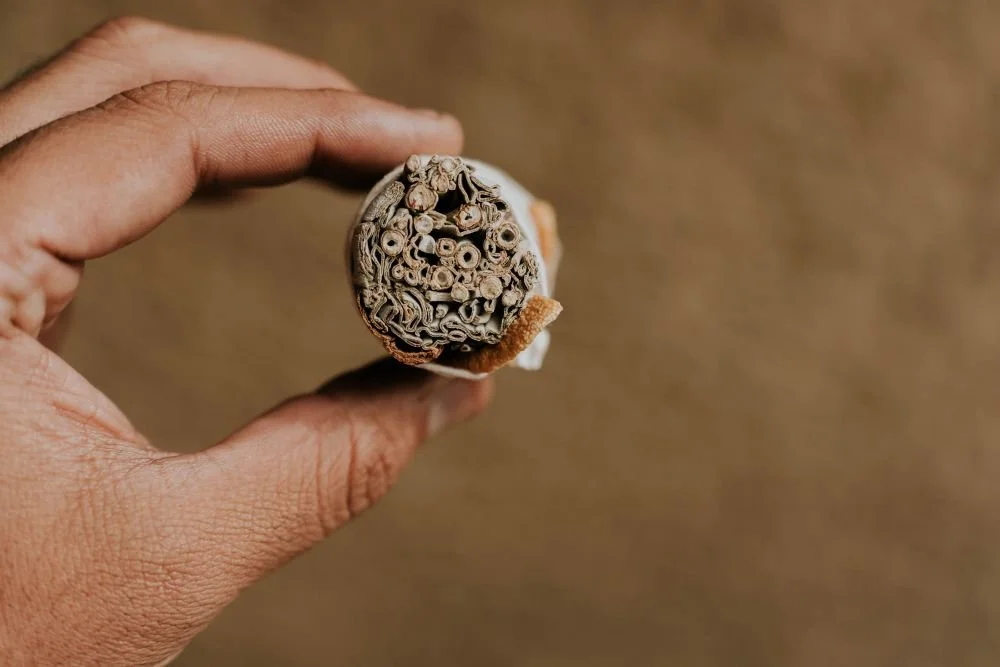
The strongest interpretation of this study is not that psilocybin has solved tobacco dependence.
It is that 40.5 percent of a carefully selected group achieved biochemically verified prolonged abstinence six months after one supervised psilocybin session delivered within a sustained CBT program, compared with 10 percent receiving nicotine patches and CBT.
That difference is too large to dismiss and too preliminary to universalize.
The next trial must determine whether the result survives larger samples, stronger comparators, more diverse populations, balanced professional contact, and longer follow-up. It must also establish whether such an intensive model can become accessible without sacrificing safety or clinical rigor.
Addiction is often described as a failure to stop. Clinical practice knows it more accurately as a pattern that has acquired too many functions to release easily.
If psychedelic therapy has a place in smoking cessation, its deeper contribution may not be the removal of nicotine from the body. It may be the temporary opening of a space in which a person can imagine that the habit is no longer the structure holding the day together.
Science must now determine whether that opening can become durable care.
