
How to Become a Certified Psilocybin Facilitator: Requirements, Training, and Career Path (2026)
Updated June 2026 · Reviewed by Changa Institute faculty
Quick answer: To become a certified psilocybin facilitator in the United States, you must be at least 21, complete a state-approved training program (roughly 150–160 hours of instruction plus a supervised practicum and consultation hours), pass a background check, and apply for licensure through your state's regulatory body, the Oregon Health Authority (OHA) in Oregon, the Department of Regulatory Agencies (DORA) in Colorado, or the Department of Health in New Mexico. Most candidates complete the path in 6–12 months.
Psilocybin facilitation is one of the fastest-growing licensed professions in behavioral health. Since Oregon's Measure 109 created the nation's first regulated psilocybin services program, three states have built legal pathways for trained facilitators, and demand for qualified professionals continues to outpace supply.
This guide walks through exactly what a psilocybin facilitator does, the legal landscape in 2026, state-by-state certification requirements, training costs, and what facilitators earn.
What Is a Psilocybin Facilitator?
A psilocybin facilitator is a state-licensed professional trained to guide clients through legal psilocybin sessions, from preparation and screening, through the administration session itself, to post-session integration. Facilitators are responsible for client safety, informed consent, and creating the structured, supportive environment that regulated psilocybin services require.
Changa Institute graduates became the nation's first licensed psilocybin facilitators in 2023, and our alumni now operate more than a third of Oregon's licensed psilocybin service centers.
Psilocybin Facilitator vs. Psychedelic Therapist vs. Trip Sitter
These roles are often confused, but they differ in scope, training, and legal standing:
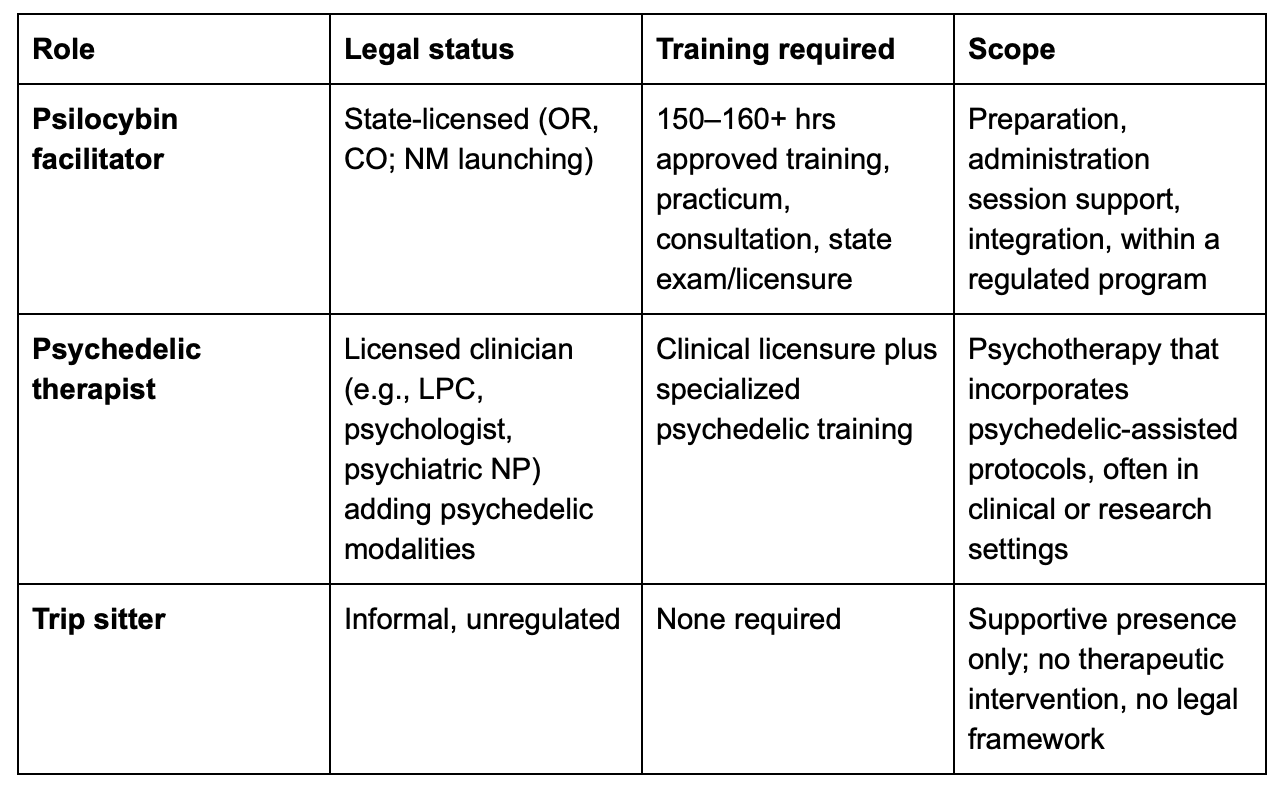
If you intend to practice legally and professionally, facilitator licensure (or clinician-pathway training) is the route. Trip sitting is not a licensed role and offers no legal protection.
What Does a Psilocybin Facilitator Do?
A facilitator's responsibilities span three phases:
Preparation. Screening clients for contraindications, establishing informed consent, setting expectations, and building therapeutic rapport before any medicine is administered.
Administration. Maintaining a safe, comfortable setting throughout the session; monitoring physical and emotional state; providing grounded, non-directive support during challenging moments; and upholding strict ethical and professional boundaries.
Integration. Debriefing the experience, helping clients translate insights into durable change, and recognizing when referral to a licensed mental health professional is appropriate.
Underneath all three phases sits the discipline the work actually demands: trauma-informed care, cultural humility, crisis response, scope-of-practice awareness, and ethics. This is the core of any serious psilocybin facilitator training curriculum.
Where Is Psilocybin Facilitation Legal in 2026?
Three states have regulated frameworks, each with its own regulator and entry requirements:
Oregon (Measure 109). The first regulated psilocybin services program in the country. Facilitators train through OHA-approved programs and license through the Oregon Health Authority. No prior clinical license is required. Learn about Oregon certification →
Colorado (Natural Medicine Health Act). Facilitators license through the Department of Regulatory Agencies (DORA), with required training, practicum, and 50 hours of consultation. Learn about Colorado certification →
New Mexico (Medical Psilocybin Act, 2025). A clinician-forward medical model: licensed healthcare providers will deliver psilocybin-assisted care for conditions including treatment-resistant depression and PTSD, with the Department of Health targeting program launch by the end of 2026. Your existing provider license is your entry point; specialized training prepares you to use it. Learn about New Mexico training →
Changa Institute is the only facilitator training program approved by all three major regulatory bodies governing psilocybin education in the U.S., OHA and HECC in Oregon, and DORA in Colorado, with New Mexico programming built for the state's 2026 framework.
How to Become a Certified Psilocybin Facilitator: 6 Steps
Step 1: Confirm your state's legal pathway
Certification is state-specific. Decide where you intend to practice first, then work backward from that regulator's requirements. Oregon and Colorado license non-clinicians; New Mexico requires an existing healthcare provider license.
Step 2: Meet baseline eligibility
Requirements vary slightly by state, but expect to need:
To be at least 21 years old
A high school diploma or equivalent (Oregon/Colorado); a current provider license (New Mexico)
A criminal background check
CPR/Basic Life Support certification (program-dependent)
Step 3: Complete a state-approved training program
This is the step that determines the quality of your career, not just your eligibility. Your program must be approved by your state's regulator, and ideally accredited as an educational institution, not just approved as a curriculum.
Changa Institute's Psilocybin Facilitator Certificate Program is a 4.5-month, cohort-based hybrid program: live instruction three times weekly on Zoom, asynchronous coursework, and small cohorts capped for mentorship. The curriculum spans the pharmacology of psilocybin, trauma-informed and culturally responsive care, ethics and boundaries, crisis intervention, group dynamics, and integration practice — built on the evidence base that informed state rulemaking, and refined across 500+ trained practitioners. Our students graduate at an 83% completion rate.
Step 4: Complete your practicum and consultation hours
States require supervised, hands-on experience, in Oregon, a 40-hour practicum; in Colorado, practicum plus 50 hours of consultation over six months. Changa offers an in-house practicum program with legal psilocybin sessions at a licensed service center, plus clinical supervision and consultation designed to meet DORA requirements.
Step 5: Apply for state licensure
After training, apply through your regulator (OHA in Oregon, DORA in Colorado). You'll submit proof of training hours, pass your background check, pay licensing fees, and in some cases complete an exam. Once licensed, you may practice at licensed service centers or, depending on the state, establish your own.
Step 6: Build your practice
Licensed facilitators work in psilocybin service centers, group practices, retreat settings (in legal jurisdictions), and integration-focused private practice. More than a third of Oregon's licensed service centers are operated by Changa alumni, a network that matters when you're looking for practicum placements, referrals, and your first role.
How to Choose a Psilocybin Facilitator Training Program
Not all approved programs are equal. Before enrolling anywhere, ask:
Is it approved by the regulator in the state where you'll practice? OHA/HECC approval doesn't transfer to Colorado, and vice versa, look for multi-state approval if you want optionality.
Who teaches it? Look for faculty with direct clinical-trial, facilitation, and regulatory experience, not just enthusiasm for the field.
Does it include a real practicum pathway? Supervised hours with actual clients at a licensed center are a legal requirement and the hardest component to arrange on your own.
What do its graduates actually do? Graduation rates, licensure outcomes, and alumni-operated practices are the honest measures of a program.
Does it prepare you for where the field is going? State rules evolve. Programs founded by people who helped write those rules will keep you ahead of them.
Changa Institute was built around those five questions: government accreditation across Oregon, Colorado, and New Mexico; faculty drawn from institutions including NYU, Johns Hopkins, and Columbia; an in-house practicum; and a founding team that served on psilocybin rulemaking committees in all three regulated states.
How Much Does Psilocybin Facilitator Training Cost?
Tuition at approved programs typically runs $7,000–$12,000, with practicum and consultation sometimes priced separately. Many programs, Changa Institute included, offer payment plans, and needs-based support exists in the field, including the Sheri Eckert Foundation scholarship for Oregon trainees. Factor in state licensing and application fees (commonly $100–$250, varying by state) when budgeting.
How Much Does a Psilocybin Facilitator Make?
Income varies widely by state, setting, and caseload. Published estimates for full-time facilitators generally range from roughly $50,000 to $80,000+ per year, with facilitators who own or co-operate service centers, maintain integration practices, or combine facilitation with an existing clinical license earning at the higher end. As New Mexico's medical program launches and additional states advance legislation, demand for licensed facilitators is expected to grow faster than training capacity.
Is Psilocybin Facilitation the Right Career for You?
This work rewards people who bring both scientific rigor and genuine presence, practitioners willing to master pharmacology, ethics, and regulation while holding space for some of the most vulnerable moments in a client's life. It is demanding, regulated, and deeply meaningful.
If you're weighing where your background and scope fit, take the Changa Journey Quiz, a short assessment that maps your experience to the right training pathway, or book a call with our admissions team.
Frequently Asked Questions
How long does it take to become a certified psilocybin facilitator? Most candidates complete the path in 6–12 months: a 4–5 month approved training program, followed by practicum hours, consultation requirements (where applicable), and state licensure processing.
Do I need a degree or clinical license to become a psilocybin facilitator? In Oregon and Colorado, no, a high school diploma or equivalent meets the educational baseline, though many trainees come from counseling, nursing, medicine, and coaching backgrounds. In New Mexico, the Medical Psilocybin Act requires an existing healthcare provider license.
What states allow licensed psilocybin facilitators in 2026? Oregon (via Measure 109, regulated by OHA) and Colorado (via the Natural Medicine Health Act, regulated by DORA) license facilitators today. New Mexico's clinician-based medical program is targeting launch by the end of 2026, with additional states advancing legislation.
How many training hours are required? Expect roughly 150–160 hours of approved instruction, plus a supervised practicum (40 hours in Oregon) and, in Colorado, 50 hours of consultation over six months. Exact requirements are set by each state's regulator.
Is Changa Institute's program state-approved? Yes. Changa Institute is the only psilocybin facilitator training program approved by all three major regulatory bodies governing psilocybin education in the U.S., the Oregon Health Authority (OHA), Oregon's Higher Education Coordinating Commission (HECC), and Colorado's Department of Regulatory Agencies (DORA), with a New Mexico program built for the state's Medical Psilocybin Act framework.
Can I take psilocybin facilitator training online? Largely, yes. Changa's program is hybrid: live instruction over Zoom plus asynchronous coursework, with the in-person practicum completed at a licensed psilocybin service center as state rules require.
Changa Institute is the nation's first government-accredited psilocybin facilitator training program. Since 2023, our graduates, the first licensed psilocybin facilitators in the United States, have gone on to operate more than a third of Oregon's licensed service centers. Explore our Oregon, Colorado, and New Mexico programs.